Customer acquisition costs are up 40% in the last two years across nearly every paid channel. Meanwhile, average retail retention is still stuck at around 63%, meaning more than a third of the customers you pay to acquire never come back.
Most Shopify brands can tell you their CAC to the penny.
Very few can say with the same confidence what their retention programme is actually worth.
That’s the gap a Retention P&L is designed to close: a simple, board-level way to prove that CRM and retention spend drive real profit (not just opens and clicks).
We broke this down in a recent webinar with Craig Kent, founder of CRM consultancy The CRM Guru.
Here’s the framework, plus our own take on where direct mail fits into it.
Why Retention Is Under More Pressure Than Ever
A few forces are working against retention right now:
- More competitor choice: crowded categories mean more switching behaviour
- Higher price sensitivity: as budgets tighten, the cost of switching brands drops
- Channel fatigue: email, paid social, and standard CRM comms have become too noisy
- Weak onboarding: customers churn before they ever see real value
- The 0–7 day cliff :this is where the most churn happens before retention marketing can even step in
That last point matters most – if a customer is going to leave, it usually happens in the first week.
The 3 Questions Leadership Actually Asks About Retention
Open rates and click-through rates don’t mean much in a boardroom. What CFOs and founders actually want answered to is:
- What’s our real returning customer rate, LTV, and payback, by cohort? Not merged across the whole customer base. A customer nurtured for 12 months behaves nothing like someone won from a Meta ad last week.
- Which retention activities are genuinely driving profit? (not just reporting opens and clicks)
- Can we build a retention P&L simple enough that leadership actually trusts it?
If a marketing team can’t answer these three questions clearly enough, your retention programme is basically invisible to whoever controls the budget.
Craig Kent’s 4-Step Retention P&L Framework
This is the core of the framework, and where we think postal marketing has a specific, measurable function in any retention strategy.
Step 1: Segment Customers by Value
Start by segmenting the customer base by behaviour, lifecycle stage, or engagement -not just by how recently someone purchased.
One useful lens: out of every 100,000 customers who’ve ever bought from a brand:
- 30,000 are on an always-on retention programme and responding well
- 30,000 are “promiscuous” (they dip in and out and are unpredictable)
- 40,000 have been targeted repeatedly across email, paid social, and CRM, but simply haven’t moved
That last group – it isn’t gone.
They’re simply blocking out every digital channel a brand can throw at them… BUT that just makes them a strong test audience for a channel they haven’t seen yet.
Step 2: Define the Moments That Matter
Map out the specific moments across the customer lifecycle that actually move the needle ( e.g. a second order within 7 days, a referral after positive feedback, a lapsed subscriber at the 60-day mark). These moments, not calendar-based campaigns, should drive when and how retention activity triggers.
Step 3: Assign Cost by Tactic and Channel
Match the channel to the moment instead of defaulting to email for everything. For example: email plus a postal trigger for a 7-day second-order push, or SMS for a referral ask. This is where postal marketing naturally slots in. And that’s not as a replacement for digital retention, but as the channel aimed specifically at the audience you’ve already exhausted online.
90% of business leaders rate direct mail as effective for winning back dormant or churned customers, and 94% say it performs even better when integrated with other channels rather than run in isolation.
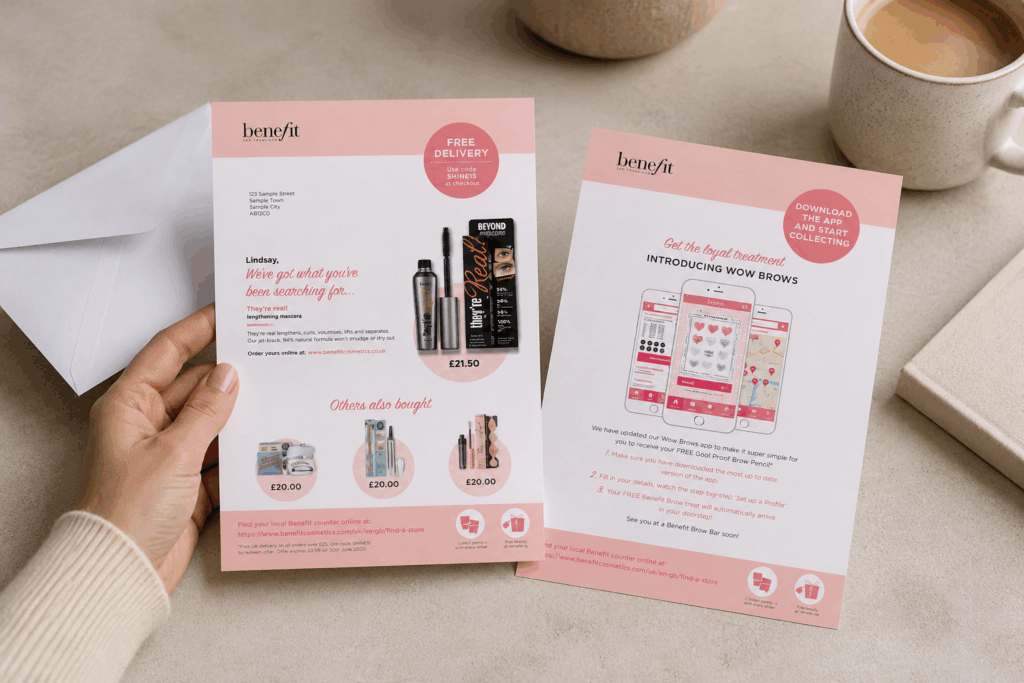
The proof in the pudding: Benefit Cosmetics saw a mid-campaign sales increase after triggering postal marketing, with engagement above 28%.
They sucessfuly cut through when digital channels were staying silent.
Step 4: Measure Repeat Orders, Contribution, and Payback
Apply the same discipline to retention that digital channels already apply to acquisition:
- Returning customer rate: how many people come back at all
- Repeat purchase rate: of those who return, how many buy again, and how fast
- Cohort LTV : broken down by segment and behaviour, not blended
- Contribution margin: actual profit driven, after the cost of the channel or incentive
- Payback by channel/segment: which specific channels are earning back their spend, and over what timeframe
Direct mail payback windows can run up to 60 days, which is far longer than most digital channels, and sustains sales cover over a longer period. This really matters when measuring true incremental value.
For more advanced programmes: Try running test-and-control on every channel, holding out roughly 20% of an audience, to prove real incrementality.
A Quick Reality Check on Email Benchmarks
Why this framework matters: even “good” email performance doesn’t go as far as it looks on paper.
Average e-commerce benchmarks sit around 35-45% open rate, just 2.5-5% click-through, and only 1.5-3.5% conversion from that click. Even that last figure is often inflated, since some of that conversion is being driven by Meta, organic, or Google rather than the email itself.
That’s also part of why the unresponsive segment of a customer base needs more than another email to move.
Where This Leaves Shopify Brands
The brands winning at retention right now aren’t necessarily spending more, they’re just being more deliberate about which channel reaches which customer, at which exact moment in their lifecycle.
A Retention P&L makes that deliberateness visible, measurable, and most importantly, trusted by the people who control the budget.
See how this plays out in practice: browse real direct mail case studies from brands already running triggered postal marketing alongside their CRM.
Watch the full webinar below, or scroll down for FAQs:
FAQ
What is a Retention P&L? A Retention P&L is a way of measuring customer retention activity with the same financial rigour applied to acquisition spend (tracking returning customer rate, cohort LTV, contribution margin, and payback by channel), rather than surface-level metrics like opens and clicks.
Why is customer retention harder to prove than acquisition? Acquisition has clear, attributable spend-to-outcome tracking. Retention activity often gets measured through vanity metrics (opens, clicks) that don’t translate cleanly into profit, which makes it harder for marketing teams to prove its value to CFOs)
How does postal marketing fit into a retention strategy?
Postal marketing performs well as a channel specifically for customers who’ve already been exhausted by digital retention efforts (email, paid social, SMS). Because it’s not competing in the same saturated inbox or feed, it tends to cut through where other channels have fallen off.