Two Channels, One Question: Where Should Your Next Pound Go?
Google Ads has been the default performance marketing channel for UK ecommerce brands for over a decade. And for good reason, it puts your products in front of people actively searching for them. But in 2026, the economics of Google Ads are changing in ways that demand a serious conversation about where your marketing budget delivers the strongest returns.
Meanwhile, direct mail, specifically programmatic direct mail has quietly become one of the highest-ROI channels available to ecommerce brands. Not the batch-and-blast junk mail of the past, but targeted, personalised, behaviour-triggered physical communications that deliver measurable results at scale.
This isn’t an argument for abandoning Google Ads. It’s an honest comparison of the two channels on the metrics that actually matter so you can make informed decisions about how to allocate your budget for maximum commercial impact.
Cost Per Click vs Cost Per Mail Piece
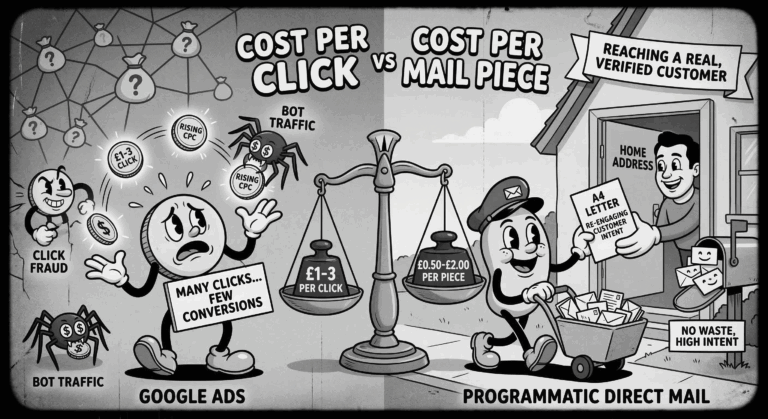
Google Ads operates on an auction-based cost-per-click (CPC) model. In competitive UK ecommerce categories, CPCs have been rising steadily year-on-year. For popular product categories like fashion, beauty, electronics, and home goods, you’re often paying £1-3 or more per click and that’s before considering that only a fraction of those clicks will convert into purchases.
A programmatic direct mail piece typically costs between £0.29 and £2.00 depending on format (postcard vs A4 letter), volume, and personalisation complexity. On the surface, that might seem comparable to a Google Ads click. But here’s the critical difference: every mail piece reaches a real, verified customer at their home address. There’s no click fraud, no bot traffic, no accidental clicks, and no wasted impressions served to people who will never buy.
More importantly, the people receiving programmatic direct mail aren’t cold traffic, they’re customers who have already visited your site, added items to their basket, or purchased from you before. They’ve already demonstrated intent. The mail piece is re-engaging them at a moment when their interest has been proven, not trying to capture attention from scratch.
Attention and Engagement
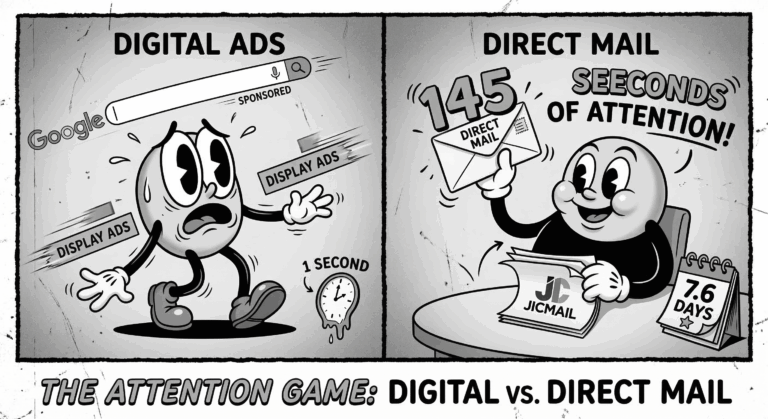
This is where the comparison becomes stark. A Google Ads search result gets a momentary glance, perhaps a second or two of attention before the user either clicks or scrolls past. Display ads receive even less.
Direct mail operates in a completely different attention environment. According to JICMAIL, the UK’s independent mail measurement body, the average piece of direct mail receives 145 seconds of attention over a 28-day period. It’s interacted with 4.56 times and stays in the home for 7.6 days (JICMAIL Q1 2025). JICMAIL’s own analysis suggests that a single mail item delivers up to 80 times more undivided attention than an in-feed social media ad (Two Sides / JICMAIL Q2 2025).
When measured on a cost-per-minute-of-attention basis, direct mail costs approximately 11p per minute (MarketReach / JICMAIL, 2025). That makes it one of the most attention-efficient media channels available to UK marketers.
Conversion Rates
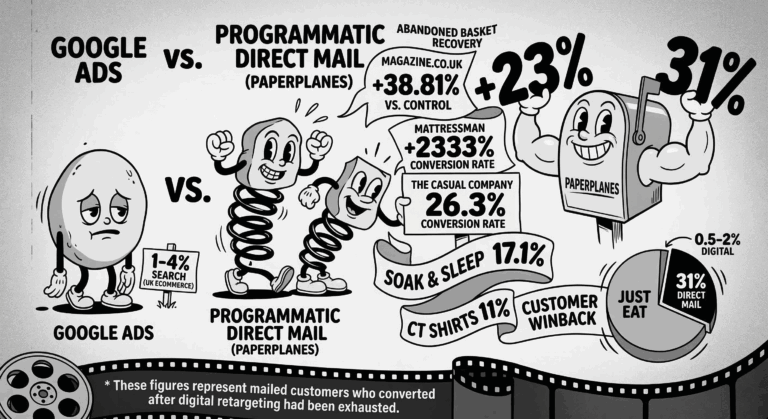
Google Ads conversion rates for ecommerce vary significantly by industry and campaign type, but the typical range for UK ecommerce is between 1-4% for search campaigns. Display and video campaigns typically convert at lower rates. These are clicks-to-purchase conversions, meaning you’re paying for every click regardless of whether it leads to a sale.
Programmatic direct mail conversion rates, measured as the percentage of mailed customers who go on to make a purchase consistently exceed these figures for comparable audience types. Here’s a selection of real conversion rates from UK ecommerce brands using Paperplanes:
For abandoned basket recovery: Magazine.co.uk achieved 38.81% higher conversions than their control group. Mattressman saw 233% higher conversion rates. The Casual Company achieved a 26.3% conversion rate. Soak & Sleep reached 17.1%. CT Shirts hit 11%. These figures represent customers who were mailed and subsequently converted an audience that had already been through digital retargeting without responding.
For customer winback: Just Eat achieved a 31% conversion rate from direct mail versus 0.5-2% from their digital channels. This single comparison illustrates the scale of difference direct mail can deliver when reaching audiences that digital has already exhausted.
Return on Ad Spend (ROAS)
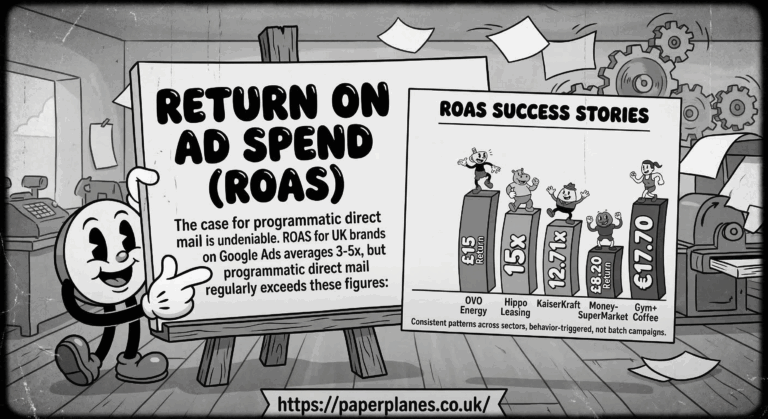
ROAS is where the commercial case for programmatic direct mail becomes undeniable. While Google Ads ROAS varies widely with many UK ecommerce brands targeting 3-5x ROAS as a benchmark for profitability programmatic direct mail regularly exceeds these figures:
AG1 achieved 19x ROAS from their programmatic direct mail campaigns. OVO Energy saw a £15 return per mail piece. Hippo Leasing generated a 15x return on high-value contracts. KaiserKraft achieved 12.71x ROAS. MoneySuperMarket delivered £8.20 return on investment. Gym+Coffee saw €17.70 ROAS.
These aren’t cherry-picked results from ideal conditions they represent the consistent performance pattern across brands in different sectors, at different price points, with different customer profiles. The common factor is that all used behaviour-triggered programmatic direct mail, not batch campaigns.
Audience Quality
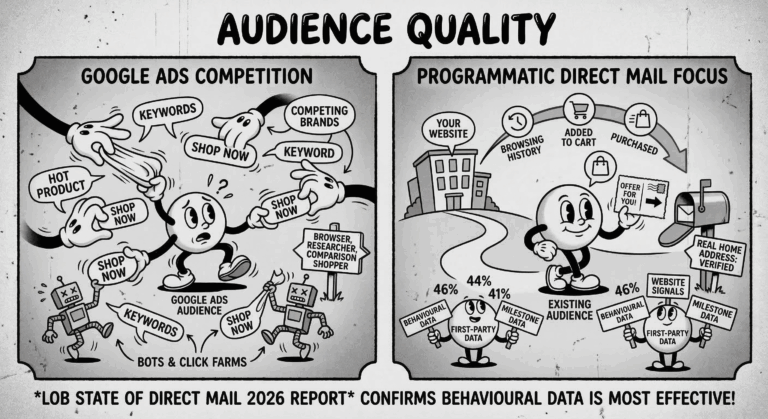
Google Ads reaches people who are searching for your product category which is powerful for acquisition. But it also means you’re competing with every other brand bidding on the same keywords, and the audience quality varies enormously. A significant proportion of clicks come from comparison shoppers, researchers, and browsers who may never purchase.
Programmatic direct mail targets your existing audience: people who have already visited your site, browsed specific products, added to basket, or purchased previously. These are customers with demonstrated interest in your brand, and the mail reaches them at their home address a verified, real-world touchpoint that confirms they’re a genuine person, not a bot or a click farm.
The Lob State of Direct Mail 2026 Report confirms that the most effective data for driving direct mail response is behavioural: website browsing behaviour (46%), communication preferences (44%), and milestone data (41%) all of which are first-party signals from your own customer data.
Privacy and Platform Risk
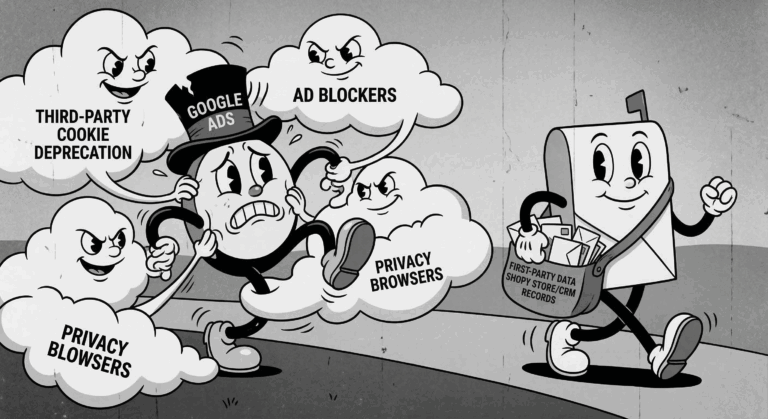
Google Ads performance is increasingly affected by factors outside your control. Third-party cookie deprecation, increased use of ad blockers, VPNs, and privacy-focused browsers all reduce the precision of Google’s targeting. Algorithm changes can dramatically alter campaign performance overnight, and rising competition means you’re perpetually bidding more for the same audience.
Direct mail is immune to these digital platform risks. It runs on first-party data your own customer records and behavioural data from your Shopify store or CRM. There are no cookies to deprecate, no algorithms to change, and no ad auctions to compete in. A customer’s postal address doesn’t get blocked by an ad blocker.
For brands concerned about the long-term sustainability of their marketing mix, direct mail provides a stable, platform-independent channel that you control.
The Integration Play: Using Both Together
The most effective approach isn’t choosing one channel over the other it’s using them together strategically.
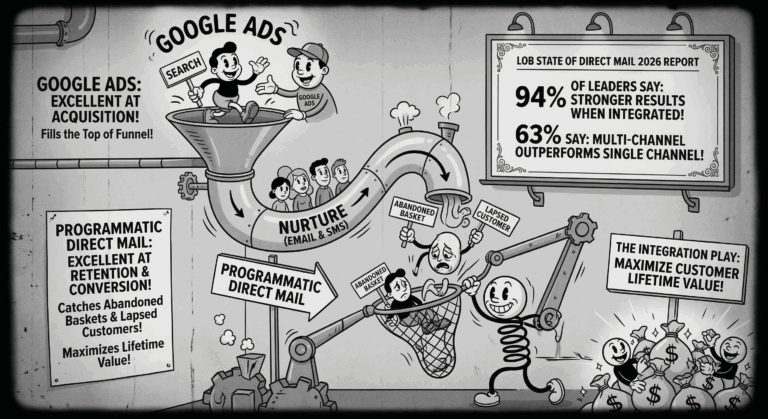
Google Ads excels at acquisition: capturing demand from customers actively searching for products like yours. It’s your front door, bringing new customers to your site.
Programmatic direct mail excels at retention and conversion: recovering abandoned baskets, reactivating lapsed customers, driving repeat purchases, and reaching customers who have stopped engaging with your digital communications. It’s the channel that maximises the lifetime value of the customers Google helped you acquire.
The Lob State of Direct Mail 2026 Report reinforces this approach: 94% of marketing leaders say direct mail delivers stronger results when integrated with other channels, and 63% say a multi-channel journey outperforms any single channel in isolation.
A practical way to think about it: Google Ads fills your funnel at the top. Email and SMS nurture in the middle. And programmatic direct mail catches everyone who falls through the cracks, the abandoned baskets your emails didn’t recover, the lapsed customers your retargeting ads couldn’t reach, and the high-value segments who deserve a premium touchpoint.
Where to Allocate Budget
If you’re currently spending 100% of your performance budget on Google Ads and Meta, consider reallocating 10-15% to a programmatic direct mail pilot. Start with abandoned basket recovery, it targets your highest-intent audience, delivers the most immediate results, and gives you clear data to evaluate the channel.
Most brands that run a pilot find that direct mail delivers incremental revenue that their digital channels were unable to capture, not cannibalised revenue from existing conversions. This is because direct mail reaches customers at a different point in their journey, through a different medium, in a different context and consistently converts people who have already been served digital ads and emails without responding.
The result is a higher overall ROAS for your marketing mix, a more resilient multi-channel strategy, and a customer base that receives genuinely personalised communications rather than the same retargeting ad following them across the internet.
Ready to see how direct mail ROAS compares to your current Google Ads performance? Talk to Paperplanes about a pilot using your own customer data and let the results speak for themselves.
Sources and References
- JICMAIL (Joint Industry Committee for Mail) — UK’s independent mail measurement body. Panel data from 1,100+ UK households collected by Kantar.
- JICMAIL Q1–Q2 2025 Quarterly Results — 145 seconds attention, 4.56 interactions per item, 7.6-day in-home lifespan.
- JICMAIL, “The Time We Spend With Mail” Attention Study — Validated by Lifestream AI video analytics, scrutinised by PwC.
- Two Sides / JICMAIL Q2 2025 — Mail delivers up to 80x more undivided attention than in-feed social ads.
- MarketReach / JICMAIL, “Mail: The Super Touchpoint” (2025) — 96% engagement rate, 11p per minute of attention, cost-efficiency analysis.
- Lob, “State of Direct Mail 2026” Report — 94% of leaders say integration strengthens results; 84% use predictive models; behavioural data drives strongest response.
- Paperplanes UK Case Studies — First-party campaign performance data from 60+ UK and international ecommerce brands. Individual case studies linked throughout this article.